April 2026 Lawn Care: What to Do Right Now
April separates the lawns that look great all summer from the ones overrun with dandelions by June. Your grass is actively growing now, soil temps are climbing, and the fertilization window is wide open. What you do in the next four weeks sets the trajectory for the entire season.
What Should Cool-Season Lawns Do in April?
Cool-season grasses like Kentucky bluegrass, tall fescue, and perennial ryegrass hit their first real growth surge in April across Zones 2-7. This is the month to establish your mowing routine and get the first fertilizer application down.
Fertilize: First Real Application of the Season
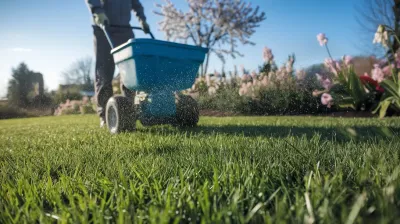
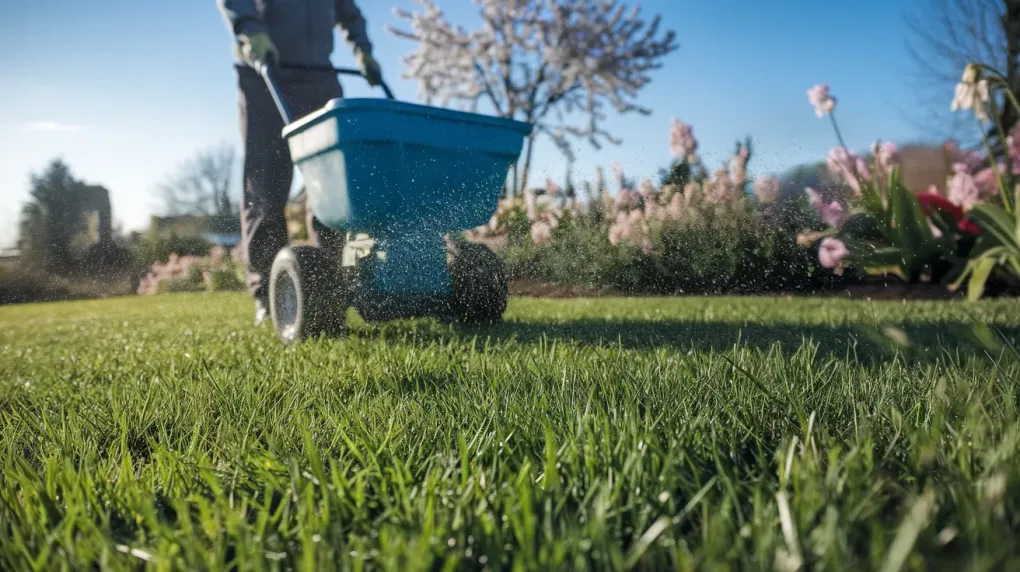
April is the time for your first meaningful nitrogen application on cool-season turf. Apply 0.75 to 1 lb of nitrogen per 1,000 square feet. A slow-release product like Milorganite or Scotts Turf Builder works well here because it feeds gradually over 6-8 weeks.
One thing that stands out from working on hundreds of residential lawns: homeowners who use slow-release nitrogen in spring have far fewer fungal issues in summer. Quick-release products push rapid blade growth that outpaces root development.
If you didn’t get a soil test done in March, do it now before fertilizing. Your local university extension office offers soil testing for $10-20. Without a soil test, you’re guessing at what your lawn actually needs.
Begin Regular Weekly Mowing
Start mowing at 3 to 3.5 inches for Kentucky bluegrass and tall fescue. Perennial ryegrass does well at 2.5 to 3 inches. The one-third rule applies every time: never remove more than one-third of the blade height in a single mowing.
| Cool-Season Grass | April Mowing Height | Mowing Frequency |
|---|---|---|
| Kentucky Bluegrass | 3 - 3.5 inches | Weekly |
| Tall Fescue | 3.5 - 4 inches | Weekly |
| Perennial Ryegrass | 2.5 - 3 inches | Weekly |
| Fine Fescue | 3 - 3.5 inches | As needed |
Sharpen your mower blades if you haven’t already. Dull blades tear grass tips, leaving brown edges that invite disease. A freshly sharpened blade cuts clean and lets the grass heal faster.
Start Irrigation If Rain Falls Short
Cool-season lawns need about 1 inch of water per week during active growth. Use a rain gauge or empty tuna can to measure what your sprinklers actually deliver. Most homeowners overestimate how much water their system puts out.
Water early in the morning, ideally before 10 AM. Evening watering leaves moisture on blades overnight, which encourages fungal diseases like brown patch and dollar spot. You can use our watering calculator to dial in the right amount for your lawn size.
Monitor for Broadleaf Weeds
Dandelions, clover, and chickweed are actively growing in April. If you applied pre-emergent in March, you’re in decent shape for crabgrass. But broadleaf weeds often punch through pre-emergent barriers.
Spot-treat individual weeds with a selective broadleaf herbicide rather than blanket-spraying the entire lawn. Products containing 2,4-D, dicamba, and mecoprop (the “trimec” combination) handle most common broadleaf weeds. According to Purdue University Turfgrass Science, targeted spot applications reduce herbicide use by up to 80% compared to broadcast spraying.
For a deeper look at tackling spring broadleaf weeds, check out our complete spring lawn care checklist.
What Should Warm-Season Lawns Do in April?
Warm-season grasses across Zones 7-10 are waking up from dormancy in April. Bermuda, zoysia, St. Augustine, and centipede are all transitioning from brown to green, but each one has different timing.
Bermuda and Zoysia: First Fertilizer After Green-Up
The rule is straightforward: wait until your bermuda or zoysia is at least 50% green before applying fertilizer. Feeding dormant or semi-dormant grass wastes product and gives weeds a competitive advantage.
Once bermuda hits 50% green-up, apply 0.5 to 0.75 lb of nitrogen per 1,000 square feet. Zoysia gets the same rate. A light application now is better than a heavy one. You’ll have plenty of opportunities to feed these grasses throughout summer. For more on bermuda’s growth cycle and fertilization schedule, read our bermuda grass guide.
Mowing Heights by Grass Type
Start mowing as soon as warm-season grasses show active growth. Each grass type has a specific height range that promotes density and root health.
| Warm-Season Grass | April Mowing Height | Notes |
|---|---|---|
| Bermuda (common) | 1.5 - 2 inches | Lower for hybrid bermuda (0.5 - 1.5”) |
| Zoysia | 1 - 2 inches | Depends on cultivar |
| St. Augustine | 3 - 4 inches | Taller than most warm-season types |
| Centipede | 1.5 - 2 inches | Do NOT fertilize centipede yet in Zones 7-8 |
One detail that surprises many homeowners: centipede grass in Zones 7-8 should not receive fertilizer in April. The calendar-verified recommendation is to begin mowing but hold off on feeding until the lawn reaches full green-up in May. Fertilizing centipede too early promotes excessive growth that the root system can’t support.
Start Your Irrigation Schedule
Warm-season lawns in Zones 9-10 may already need supplemental water by mid-April. Bermuda and zoysia are drought-tolerant once established, but they green up faster and fill in thicker with consistent moisture during the spring transition.
Aim for 1 inch of water per week, split into two deep watering sessions rather than daily light sprinkles. Deep watering forces roots to grow downward, which pays off when summer heat arrives.
Watch for Weeds in Thin Spots
Any area where your warm-season turf is slow to green up becomes an invitation for weeds. Thin spots, shaded areas, and edges along sidewalks are the usual trouble zones.
If you didn’t apply pre-emergent in February or March, you may already see crabgrass seedlings emerging. Post-emergent options like quinclorac can handle young crabgrass, but effectiveness drops once plants mature. Timing matters.
Why Is Milorganite a Smart April Fertilizer Choice?
Milorganite is an organic slow-release nitrogen fertilizer with a 6-4-0 analysis. It works particularly well for April applications on both cool-season and warm-season lawns.
Here’s why it fits April so well:
- Won’t burn new growth. Organic slow-release nitrogen doesn’t cause salt burn, even on tender spring grass. This matters especially for warm-season lawns just breaking dormancy.
- Feeds soil biology. The microorganisms in your soil are waking up from winter too. Milorganite feeds those microbes, which in turn break down thatch and make nutrients available to roots.
- Predictable release rate. Milorganite releases nitrogen as soil temperatures rise, so it naturally aligns with your grass’s increasing nutrient demand through April and May.
Apply Milorganite at 32 lbs per 2,500 square feet. That rate delivers approximately 0.72 lb of nitrogen per 1,000 square feet, right in the sweet spot for a spring application.
Check Milorganite price on Amazon
If you’re comparing fertilizer options, our fertilizer reviews page breaks down the top products by grass type and budget.
What’s the Biggest April Lawn Care Mistake?
Over-fertilizing in spring is the single most common mistake I see homeowners make. It happens because the lawn looks hungry after winter, and the temptation to dump heavy nitrogen is strong.
Cool-Season Lawns: Save the Heavy Feeding for Fall
Excessive spring nitrogen on Kentucky bluegrass or tall fescue pushes lush top growth at the expense of root development. The grass looks amazing in April and May, then collapses under summer heat stress because the roots are shallow.
Research from Penn State’s Center for Turfgrass Science confirms that fall fertilization produces denser turf with better root mass than equivalent spring applications. Spring nitrogen should be moderate: 0.5 to 1 lb N per 1,000 square feet, not the 1.5 lb rates some bag labels suggest.
| Application Timing | N Rate (lbs/1,000 sqft) | Result |
|---|---|---|
| Heavy spring (1.5+ lbs N) | Fast top growth | Shallow roots, summer stress |
| Moderate spring (0.75-1 lb N) | Steady growth | Balanced root/shoot ratio |
| Heavy fall (1-1.5 lbs N) | Best density | Strong roots, winter hardiness |
Warm-Season Lawns: Don’t Feed Before 50% Green-Up
Fertilizing bermuda or zoysia that’s still mostly dormant is throwing money at weeds. The grass can’t absorb the nitrogen while dormant, but the annual bluegrass, henbit, and other cool-season weeds growing in your lawn absolutely can.
Wait for that 50% green-up threshold. It’s usually mid-to-late April in Zone 7 and early April in Zones 9-10. A soil thermometer reading of 65 degrees F at 4 inches deep is another reliable indicator that bermuda is ready for its first feeding.
April 2026 Quick-Reference Checklist
Cool-Season (Zones 2-7):
- First fertilizer application (0.75-1 lb N/1,000 sqft)
- Mow weekly at 3-3.5 inches
- Sharpen mower blades
- Start irrigation (1 inch/week if rain is insufficient)
- Spot-treat broadleaf weeds
- Soil test if not done in March
Warm-Season (Zones 7-10):
- Fertilize after 50% green-up (0.5-0.75 lb N/1,000 sqft)
- Begin regular mowing at species-appropriate height
- Start irrigation schedule (1 inch/week)
- Monitor thin areas for weed pressure
- Do NOT fertilize centipede until May (Zones 7-8)
Frequently Asked Questions About April Lawn Care
Can I apply pre-emergent and fertilizer at the same time in April?
Yes, many combination products include both pre-emergent herbicide and fertilizer. If using separate products, apply them on the same day and water in with 0.25 inches of irrigation. Timing matters more than method.
When should I start mowing in April if my lawn is still partly brown?
Begin mowing cool-season grass as soon as you see active green growth, even if some areas are still dormant. For warm-season lawns, wait until you see at least 50% green-up. Mowing dormant grass does no harm, but it also does no good.
Is April too late for pre-emergent herbicide?
In Zones 6-7, April is borderline for crabgrass pre-emergent. Soil temps above 55 degrees F at 4 inches for three consecutive days means crabgrass is already germinating. In Zones 3-5, early April still works.
How much should I water my lawn in April?
Target 1 inch per week total, including rainfall. Measure with a rain gauge. In cooler northern zones, natural rainfall often covers this. In Zones 8-10, you may need to supplement with irrigation starting mid-April.
Should I dethatch my lawn in April?
Cool-season lawns should be dethatched in early fall, not spring. For warm-season grasses like bermuda and zoysia, late spring (May-June) after full green-up is the better window. Dethatching during spring transition stresses the turf.
What if I missed my March pre-emergent application?
Apply it immediately. A late pre-emergent is better than none. Some products like prodiamine have a wider application window than others. According to the University of Georgia Extension, applying pre-emergent even two weeks late still prevents 50-70% of crabgrass germination.
What Comes Next?
May brings grub prevention, the second round of fertilization, and the last practical window for spring weed control. Get April’s tasks done now so May’s workload stays manageable. Our spring lawn care guide maps out the full spring timeline.
That’s the DIY checklist. TurfTracker users got a notification on April 3rd saying “Your bermuda is 50% green, time for first fertilizer. Apply 0.75 lbs N per 1,000 sqft this weekend.” Which approach sounds easier? Try TurfTracker free for 7 days.