May Lawn Care: What to Do Right Now


May is grub prevention month. One application of GrubEx now stops the kind of root damage that leaves entire sections of your lawn peeling up like carpet in August. This is also your last realistic window for spring broadleaf weed control before summer heat makes herbicide applications risky.
Anton Schwarz, Resident Lawn Types Expert: “If you do nothing else in May, put down preventive grub control. I’ve walked too many late-August lawns where the homeowner is standing on what looks like a perfectly healthy yard until you grab a corner and roll it up like sod — there are no roots underneath. The lawn isn’t dying from heat or drought; it was dying in May, and the owner just hadn’t seen it yet. A $30 bag of GrubEx applied with a $50 spreader in early May is the single highest-leverage thing a homeowner can do all year. Skip it, and you’re gambling with the entire summer lawn.”
What Should Cool-Season Lawns Do in May?
Cool-season grasses in Zones 2-7 are in peak spring growth during May. Kentucky bluegrass is spreading through rhizomes, tall fescue is thickening up, and the lawn should be looking its best. Your job this month is to maintain momentum and prevent problems before they start.
Second Spring Fertilizer Application
If you applied your first round in April, May is the time for a second light feeding. Keep the rate moderate at 0.5 to 0.75 lb of nitrogen per 1,000 square feet. This isn’t the time for heavy nitrogen. That’s what September and October are for.
A slow-release product stretches the feeding window and avoids the surge-and-crash growth pattern that quick-release fertilizers cause. Last spring, a homeowner in Ohio showed me his lawn after three consecutive years of heavy spring feeding. Looked incredible in May, turned into a brown patch disaster every July. Root systems were almost nonexistent below two inches.
Mow Weekly at 3-3.5 Inches
The one-third rule still governs everything. If you’re maintaining at 3.5 inches, mow when the grass reaches about 5 inches. Kentucky bluegrass and perennial ryegrass may need mowing every five to six days in May as growth rates peak.
Leave the clippings on the lawn. Grass clippings decompose quickly and return roughly 25% of the nitrogen you applied back to the soil. According to the University of Minnesota Extension, returning clippings reduces annual fertilizer needs by up to one full application.
| Mowing Task | Details |
|---|---|
| Height (KBG, Ryegrass) | 3 - 3.5 inches |
| Height (Tall Fescue) | 3.5 - 4 inches |
| Frequency | Every 5-7 days |
| Blade condition | Sharpen every 8-10 hours of mowing |
| Clippings | Leave on lawn (grasscycling) |
Apply Grub Prevention Now
This is the big one. Preventive grub control with chlorantraniliprole (the active ingredient in Scotts GrubEx) needs to go down in May or June, before Japanese beetle and June bug larvae hatch and start feeding on roots.
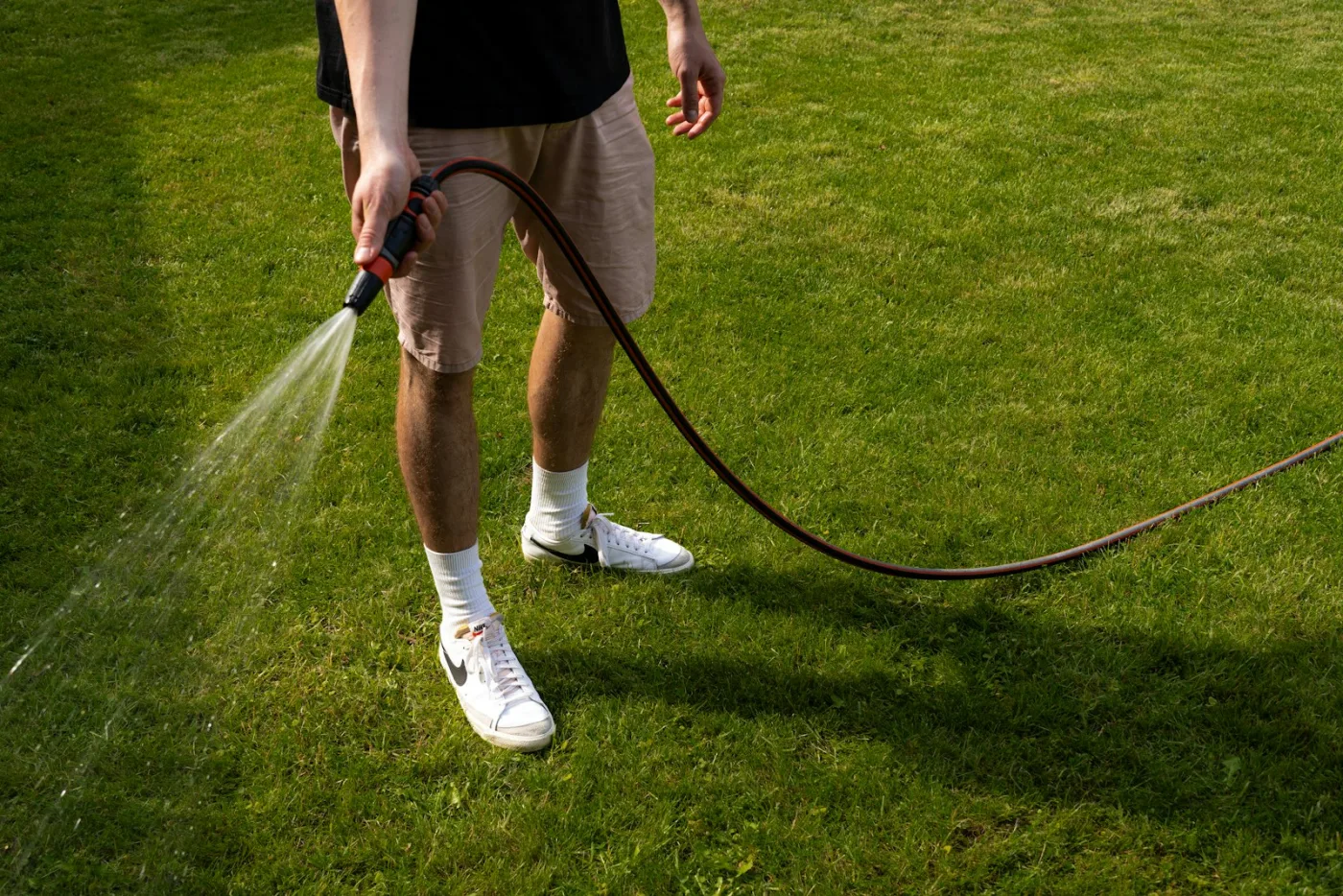
Chlorantraniliprole works by being present in the soil when eggs hatch in late June through July. It takes time to move into the root zone, which is why applying in May gives the best results. Water it in with 0.5 inches of irrigation within 24 hours of application.
Skipping grub prevention is a gamble that costs far more to fix after the fact. We’ll cover this in detail below.
Spot-Treat Broadleaf Weeds
May is your last comfortable window for broadleaf herbicide applications on cool-season lawns. Once daytime temps consistently hit 85 degrees F, most selective herbicides risk damaging your turf.
Target dandelions, clover, and plantain with a product containing 2,4-D and dicamba. Spray when weeds are actively growing and temps are between 60 and 80 degrees F. A pump sprayer with a fan-tip nozzle gives better coverage than a hose-end sprayer for targeted applications.
Our spring lawn care checklist covers the full weed control timeline from March through May.
Watch for Early Signs of Fungal Disease
Dollar spot, brown patch, and red thread all begin appearing in late May when humidity rises and nighttime temperatures stay above 60 degrees F. Early symptoms include circular brown patches 2-6 inches in diameter (dollar spot) or irregular larger patches with a dark border (brown patch).
The best defense is cultural: water in the morning, don’t over-fertilize with nitrogen, and maintain proper mowing height. Fungicides are a last resort, not a routine application.
What Should Warm-Season Lawns Do in May?
Warm-season grasses in Zones 7-10 are hitting full stride in May. Bermuda is in aggressive growth mode, St. Augustine is filling in, and zoysia is thickening up. This is the month to push growth and stay ahead of pests.
Fertilize for Full Growth Mode
Bermuda grass in full growth mode needs regular feeding. Apply 0.75 to 1 lb of nitrogen per 1,000 square feet in May. Bermuda is a heavy feeder during its active growing season and responds well to monthly applications through August.
St. Augustine gets a lighter touch: 0.5 to 0.75 lb N per 1,000 square feet. Over-fertilizing St. Augustine promotes rapid stolon growth that increases thatch buildup. For zone-specific recommendations on bermuda feeding schedules, see our bermuda grass care guide.
| Warm-Season Grass | May N Rate (lbs/1,000 sqft) | Frequency |
|---|---|---|
| Bermuda | 0.75 - 1.0 | Monthly through August |
| Zoysia | 0.5 - 0.75 | Every 6-8 weeks |
| St. Augustine | 0.5 - 0.75 | Every 6-8 weeks |
| Centipede | 0.25 - 0.5 | Once in May, once in July max |
Centipede grass needs the least nitrogen of any warm-season turf. The University of Georgia Extension recommends no more than 1-2 lbs of nitrogen per 1,000 square feet for the entire year. Exceeding that rate causes centipede decline, a condition where the grass thins out from too much fertilizer.
Deep Water 1-1.25 Inches Per Week
Warm-season grasses need deep, infrequent watering to develop strong root systems. Split your weekly inch into two sessions of 0.5 inches each, spaced three to four days apart.
Bermuda grass roots can reach 6 feet deep in sandy soils with proper deep watering. Shallow daily sprinkles keep roots in the top 2 inches, making the lawn vulnerable to drought stress the moment you skip a day. Use our watering calculator to figure out the right runtime for your sprinkler system.
Monitor for Chinch Bugs and Armyworms
St. Augustine lawns should be on high alert for chinch bugs starting in May. These tiny insects feed by sucking plant juices from grass blades, causing irregular yellow patches that turn brown. The damage often mimics drought stress.
Test for chinch bugs by pressing both ends out of a coffee can, pushing it 2 inches into the soil at the edge of a damaged area, and filling it with water. Chinch bugs float to the surface within five minutes if present.
Armyworms hit bermuda and zoysia lawns, especially in the Southeast. They feed at night and can strip a lawn bare in 48 hours. Look for birds congregating on your lawn. Flocks of starlings or grackles feeding in your turf is a reliable sign of armyworm activity underneath.
Mow Frequently
Bermuda grass may need mowing twice per week in May. This isn’t optional for a clean-looking bermuda lawn. Letting bermuda grow tall and then scalping it back stresses the plant and creates brown, stemmy patches.
Zoysia and St. Augustine hold at once per week unless growth is unusually rapid. St. Augustine stays at 3-4 inches, which means mowing when it reaches about 5 inches.
Apply Post-Emergent Herbicides for Breakthrough Weeds
Any weeds that made it past your pre-emergent barrier need targeted treatment now. For bermuda lawns, products containing atrazine handle most broadleaf and some grassy weeds. St. Augustine tolerates atrazine at labeled rates.
Do not use atrazine on zoysia or centipede without checking the product label for specific cultivar tolerance. Some zoysia cultivars are sensitive. When in doubt, hand-pull or use a targeted broadleaf-only herbicide.
Why Is Scotts GrubEx the Product of the Month?
Scotts GrubEx contains chlorantraniliprole, a preventive grub control that stops grub damage before it starts. This is the single most important preventive application of the year for lawns in Zones 4-8 where Japanese beetles, June bugs, and European chafers are common.
Key facts about GrubEx:
- Preventive, not curative. It must be in the soil before grub eggs hatch. Applying after you see damage is too late for this product.
- One application protects all season. A single May or June application provides season-long control through fall.
- Apply and water in. Spread with a broadcast spreader and irrigate with 0.5 inches of water within 24 hours. The water moves the active ingredient into the root zone where grubs feed.
- Low toxicity to pollinators when used as directed. Chlorantraniliprole has a favorable environmental profile compared to older grub control chemicals like trichlorfon.
For even application, a broadcast spreader is essential. Our fertilizer spreader reviews cover the best options from Scotts, Earthway, and Echo.
What Happens If You Skip Grub Prevention?
You won’t see the damage until August. By then, grubs have been feeding on grass roots for six weeks, and entire sections of turf pull up like loose carpet.
The Timeline of Grub Damage
Here’s what happens underground when you skip prevention:
| Month | What’s Happening Below Ground |
|---|---|
| May-June | Adult beetles lay eggs in turf |
| July | Eggs hatch, tiny grubs begin feeding on roots |
| August | Grubs are half-grown, damage becomes visible |
| September | Full-sized grubs cause severe thinning and dieback |
| October | Grubs move deeper into soil for winter |
By August, you’re stuck with curative treatments like trichlorfon (Dylox), which cost more per application and are less effective than prevention. Trichlorfon also has a narrower safety margin and requires precise timing to work.
A preventive GrubEx application costs roughly $25-35 for 5,000 square feet. Repairing grub-damaged turf (overseeding, topdressing, possibly sodding dead areas) runs $200-500 or more depending on the extent of damage.
One renovation project I worked on in central Indiana started because the homeowner skipped grub prevention for two years straight. The entire backyard, about 4,000 square feet, needed to be stripped and re-sodded. That was a $2,800 job that a $30 bag of GrubEx would have prevented.
How May Grub Prevention Transforms Your Summer Lawn
A May GrubEx application doesn’t just prevent damage. It changes the trajectory of the entire summer. Here’s what actually happens when you protect the root system in May versus when you don’t:
Lawns with May grub prevention keep their roots intact through July and August. When the lawn hits summer heat stress, those deep roots reach soil moisture six and even twelve inches down. The grass blades may yellow slightly during a heat dome, but the plant survives. Recovery in September is fast because the root system is already there. By Labor Day, the lawn looks like nothing happened.
Lawns without grub prevention look identical in May, June, and most of July. Then around the first week of August, dry-looking patches appear in random spots. Homeowners blame drought and water more. The patches get worse. By mid-August, you can lift handfuls of grass off the soil with no resistance — there’s nothing holding it down. By Labor Day, you’re staring at a 2,000 square foot patch of bare soil. Renovation costs $400 to $2,800 depending on the size and whether you DIY or hire out.
I’ve seen the same pattern repeat across more than 100 lawns I’ve consulted on over 15 years. The May grub prevention decision is the single biggest predictor of how a lawn looks in September. It’s not how much you fertilize, how often you water, or how high you mow. It’s whether you got chlorantraniliprole into the soil before late June.
Why Every Lawn Owner Needs a Broadcast Spreader
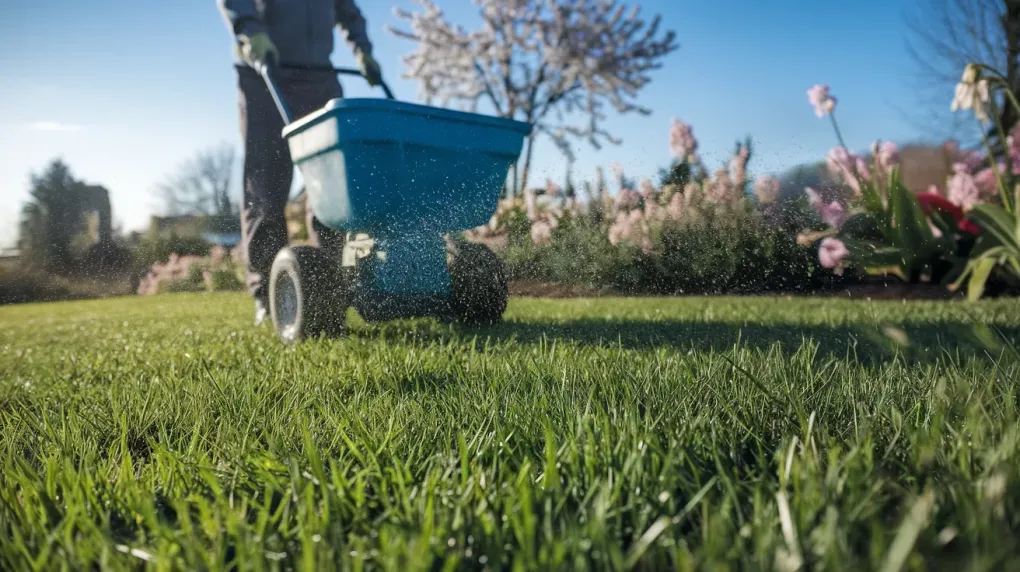
A broadcast spreader is the most underrated tool in residential lawn care. Hand-spreading fertilizer or grub control might feel like it works, but it produces uneven application — striped lawns where some areas got 2x the rate and others got nothing. Those stripes show up four weeks later when the over-fertilized strips burn brown and the under-fertilized strips stay thin and yellow.
Here’s why I tell every homeowner to budget $50 to $150 for a quality broadcast spreader before they buy any other lawn care tool except a mower:
A spreader pays for itself on the first GrubEx application. Chlorantraniliprole is only effective at the labeled rate. Hand-broadcasting bunches it in some spots and misses others, leaving grub-vulnerable zones across your lawn. A calibrated broadcast spreader applies the right rate uniformly across the entire treated area — every square foot gets the protection it needs.
The same spreader handles five separate applications per year:
- Pre-emergent crabgrass control (March-April)
- Spring fertilizer (April-May)
- Grub prevention (May-June)
- Fall fertilizer — the most important application of the year (September-October)
- Winterizer or lime (October-November)
Hand-spreading wastes product. Spilling a $30 bag of GrubEx because the bag tipped over while walking the lawn happens more often than people admit. A spreader hopper holds the product securely; you walk a planned pattern at a steady pace; the application finishes exactly when the hopper empties. No spills, no wasted product, no missed sections.
Cheap doesn’t mean useless, but ultra-cheap usually does. I’ve used broadcast spreaders ranging from $25 hardware-store specials to $400 professional units. The $25 units feel disposable — wheels wobble, the agitator inside the hopper sticks, the rate setting drifts during a single application. The $50-$150 range hits the value sweet spot.
The three I recommend most often, with confirmed homeowner pricing:
- Scotts Turf Builder EdgeGuard DLX — the entry-level pick under $100. EdgeGuard technology blocks the spread pattern on the driveway side so you don’t waste fertilizer on hardscape.
- Scotts Elite Broadcast Spreader — the upgrade pick around $130-$160. Pneumatic tires and a more reliable rate-setting mechanism. This is what I keep in my own garage.
- Earthway 2150 Commercial — the professional pick around $180-$220. Enclosed gearbox, commercial-grade build, what most landscapers actually use day-to-day. Overkill for a 5,000 sq ft suburban lawn but worth it if you have an acre or more.
Look for: an enclosed gear box (not exposed), pneumatic or solid rubber tires (not the hard plastic kind that bounce), and a control rod with a positive stop at the rate setting.
Drop spreaders are the alternative for small lawns. If your lawn is under 3,000 square feet and you have lots of bordering hardscape (mulch beds, walkways, gravel), a drop spreader gives more precise edge control than a broadcast unit. The trade-off is application time — drop spreaders apply a 22-inch wide stripe, so a 3,000 square foot lawn takes longer to cover. For most homeowners with a typical 5,000-10,000 square foot lawn, broadcast is the right call.
For full head-to-head reviews and side-by-side comparisons, see our fertilizer spreader reviews. The right spreader is the difference between an even, healthy lawn and a striped patchwork of over-fed and starved strips.
May Quick-Reference Checklist
Cool-Season (Zones 2-7):
- Second spring fertilizer (0.5-0.75 lb N/1,000 sqft)
- Mow weekly at 3-3.5 inches
- Apply GrubEx, water in within 24 hours
- Spot-treat broadleaf weeds (last spring window)
- Monitor for dollar spot and brown patch symptoms
- Maintain 1 inch/week irrigation
Warm-Season (Zones 7-10):
- Fertilize bermuda (0.75-1 lb N), lighter rates for other types
- Deep water 1-1.25 inches per week
- Check St. Augustine for chinch bugs weekly
- Watch for armyworm activity (bird feeding on lawn)
- Mow bermuda twice per week if needed
- Apply post-emergent herbicides for breakthrough weeds
Frequently Asked Questions About May Lawn Care
When exactly should I apply GrubEx in May?
Any time in May works. The active ingredient, chlorantraniliprole, has a long residual in soil. Applying in early May gives it more time to distribute through the root zone before eggs hatch in late June. Water it in within 24 hours of application. Check current GrubEx pricing on Amazon.
Can I fertilize and apply GrubEx on the same day?
Yes. Apply fertilizer first with your spreader, then make a second pass with GrubEx. Water both in with 0.5 inches of irrigation. Combination products exist, but separate applications give you more control over rates.
How do I know if I have grubs?
Cut a 1-foot-square section of turf 3 inches deep and peel it back. Count the grubs. Fewer than 5 per square foot is normal. More than 10 per square foot causes visible damage. This test works best in August and September when grubs are actively feeding.
Is it too late to apply pre-emergent in May?
For crabgrass prevention in Zones 6-7, yes. Soil temps have passed the germination threshold by May. In Zones 3-5, early May might still work if spring was cold. Check soil temps at 4 inches. Above 55 degrees F for several consecutive days means crabgrass has already started germinating.
Should I bag or mulch clippings in May?
Mulch them. Grass clippings do not cause thatch buildup. That’s a persistent myth. Clippings are 80-85% water and decompose within days. They return nitrogen, potassium, and phosphorus to the soil. The only exception is if the lawn is severely overgrown and clumps of clippings are smothering the grass underneath.
How often should I water bermuda grass in May?
Two to three times per week, delivering a total of 1 to 1.25 inches. Bermuda prefers deep, infrequent watering over daily light sprinkles. Sandy soils may need three sessions per week. Clay soils hold moisture longer and usually need just two.
What spreader do you actually recommend for a typical homeowner?
For most homeowners with a 5,000-10,000 square foot lawn, the Scotts Turf Builder EdgeGuard DLX is the entry-level pick under $100. The EdgeGuard feature blocks the spread pattern on the driveway side so you don’t waste fertilizer on hardscape. If you can stretch the budget to $130-$160, the Scotts Elite Broadcast Spreader has pneumatic tires and a more reliable rate-setting mechanism — that’s what I keep in my own garage. For lawns over an acre, step up to the Earthway 2150 Commercial which is what most professional landscapers use day-to-day.
Is GrubEx the only grub control product worth using?
Chlorantraniliprole (the active ingredient in Scotts GrubEx) is the gold standard for preventive control. It has a long residual, low pollinator toxicity, and reliable performance. Other preventive products containing imidacloprid (older Bayer Advanced formulations) work too but have a less favorable pollinator profile. For curative treatment after damage appears, switch to a trichlorfon (Dylox) product — but understand that curatives cost more and work less reliably than May prevention. Stick with GrubEx in May.
How do I calibrate my spreader correctly?
Most spreaders have a setting number printed on the bag of whatever product you’re applying. Set the rate dial to that number, fill the hopper, and walk a steady pace. To verify, weigh out a known amount of product (5 pounds for a small test), apply it to a measured area at your normal walking speed, and check whether the hopper empties in roughly the expected square footage. If you went through it too fast, the rate is too high; too slow and it’s too low. Three test passes calibrate most spreaders accurately for the season.
Can I apply GrubEx if I overseeded last fall?
Yes, GrubEx is safe on established turf — including fall-overseeded lawns by May. The chlorantraniliprole active ingredient doesn’t harm grass at any growth stage. The only timing issue is if you’re planning to overseed THIS spring (rare for cool-season but possible) — in that case, wait until the new seedlings have been mowed at least twice before applying any pesticide.
What about a sprayer for spot-treating broadleaf weeds?
A 2-gallon pump sprayer with a fan-tip nozzle is the right tool. The Chapin 20002 2-Gallon Pump Sprayer is the industry workhorse — translucent tank to see remaining product, brass nozzle, comfortable handle. For larger properties, a 4-gallon backpack sprayer pays off; for typical residential spot-treating, a 2-gallon hand-pump unit is plenty. Mix herbicide per label directions, walk the lawn, and target individual weeds rather than blasting the whole yard. The blue-dye marking trick (add a few drops of food coloring to the tank) helps you see what you’ve already sprayed.
Should I dethatch in May?
No. May is peak growth — dethatching now stresses an actively-growing lawn and creates entry points for fungal disease as humidity climbs. Dethatch in early spring (March, before greenup) for cool-season lawns or late spring/early summer (June) for warm-season lawns when bermuda or zoysia is in full growth mode and recovers fast. If your thatch layer is over 1/2 inch, plan a fall core aeration instead — it solves the same drainage problem without the dethatching stress.
What if I missed the May window for grub prevention?
Apply preventive control in early June and you’ll still be ahead of most egg hatch (which peaks late June into July in most zones). Past mid-July, switch from preventive (chlorantraniliprole/GrubEx) to curative (trichlorfon/Dylox) products since the grubs have already hatched. Curative treatment is reactive and less effective than May prevention — but it’s better than waiting for August damage. Set a phone reminder for next May 1.
What’s Coming in June?
June brings summer heat stress management for cool-season lawns and peak growth demands for warm-season turf. Raise your cool-season mowing height, maintain your irrigation schedule, and start watching for fungal pressure as humidity climbs. Our spring lawn care guide covers the transition into summer in detail.
TurfTracker monitors soil temperature in your zip code and sends a grub prevention reminder at the optimal time for your zone. No guessing, no missed windows. Try TurfTracker free for 7 days.
Lawn Care Year Navigation
| Previous | Hub | Next |
|---|---|---|
| ← April lawn care | 📅 Annual Calendar | June lawn care → |
Season hub: Spring Lawn Care Guide — full three-month spring program with cool-season and warm-season specifics.
Related Resources
- Annual Lawn Care Calendar — the complete 12-month schedule
- Best Fertilizer Spreaders — calibrated for grub control
- Bermuda Grass Guide — peak growth begins
- Lawn Pests Guide — grub prevention overview
- Grub Identification — life cycle and treatment timing