How-To Guide · Cool-Season Renovation
How to Overseed a Lawn: The September Window That Decides Next Year
September 8th, 2023, I core-aerated a Kentucky bluegrass lawn in suburban Cincinnati that had been thinning for three years straight. The homeowner had been treating symptoms — extra fertilizer, more watering — without addressing the actual cause: clay soil compacted to the point that water and oxygen weren't reaching the root zone. We pulled half-inch cores at 3-inch spacing, overseeded with a tall fescue blend at 5 lbs per 1,000 sqft, applied starter fertilizer (18-24-12), and watered for three weeks. By November 1st, the lawn was visibly thicker. By the following June, the homeowner sent me a photo with the message "best the lawn has ever looked." That entire transformation traced back to a single Saturday afternoon in September.

★ Author
Anton Schwarz, Resident Lawn Types Expert
"September 1 through December 1 — that 90-day window makes 80% of next year's lawn. Most homeowners think the spring growth is what makes a great lawn. The opposite is true. Spring shows you what fall built. Get September overseed right and spring is just maintenance."
The Single Decision That Determines Overseed Success
Timing. Not seed selection, not aeration, not watering schedule — timing. Cool-season grass seed germinates reliably when 4-inch soil temperatures sit between 50°F and 75°F. Seed dropped into 80°F soil rots before it sprouts. Seed dropped into 45°F soil sits dormant until soil rises again — sometimes the following spring.
The trigger by zone:
- Zone 4-5 — overseed September 1-10 (soil typically peaks late August, drops fast)
- Zone 6 — overseed September 8-20
- Zone 7 — overseed September 15-October 1
- Zone 8 — overseed late September through early October
Use a probe thermometer at 4-inch depth. Mid-morning shaded readings are most accurate. The single biggest reason "I overseeded and nothing came up" failures happen is that the homeowner trusted the calendar instead of the soil temp.
How Much Seed Do You Actually Need?
Two scenarios with materially different seed rates:
- Full overseed (entire lawn): 4-6 lbs per 1,000 sqft
- Spot/thin-area overseed: 2-3 lbs per 1,000 sqft
- New lawn from seed: 8-10 lbs per 1,000 sqft (different application; see starting a new lawn from seed)
For a 5,000 sqft typical residential lawn doing a full overseed: 25-30 lbs of seed total. Two 16-lb bags handles it with a small reserve.
Use the lawn size calculator if you don't have a measurement on file — the satellite-imagery tool gives accurate sqft within 2-3% which is what you need for spreader calibration.
Should You Core-Aerate Before Overseeding?
Aerate first if your soil is compacted. Three diagnostic signals:
- Water pools or runs off rather than soaking in
- The screwdriver test — push a screwdriver into the soil. If it stops within 2-3 inches under normal hand pressure, the soil is compacted.
- High-traffic areas show persistent thin turf despite normal care
For compacted soil, core-aerate before overseeding so seeds drop into the open core holes (giving them direct soil contact and protection from runoff). Time the aeration within 2 weeks of overseeding. Renting an aerator from Home Depot or Lowe's runs $60-90/day. Hiring a service runs $150-300 for a typical residential lawn.
Skip aeration on sandy soils — diminishing returns. For more on aeration timing and procedure, see our core aeration guide.
Seed Selection: Match the Existing Lawn
Don't introduce a new species into your existing lawn — match what's already there:
- Kentucky bluegrass lawns: KBG-dominant blend (Award, Midnight, Bewitched cultivars). Allow 14-21 days for germination.
- Tall fescue lawns: Turf-type tall fescue blend (Rebel, Falcon, Titan cultivars). Allow 7-14 days for germination.
- Perennial ryegrass lawns: Improved perennial ryegrass blend. Fastest germination at 5-10 days but coarser texture.
- Sun/shade mixed yards: Transitional blend with both KBG and fine fescue. Different cultivars handle different light zones.
Avoid bagged "contractor mix" — usually heavy on annual ryegrass (cheap filler that dies the following summer). Quality seed costs $5-7 per pound; budget seed costs $2-3 per pound and produces materially worse outcomes. Scotts Turf Builder grass seed is the most accessible quality option at most retailers.
Calibration Walkthrough
Bag-printed spreader settings are usually wrong. Calibrate on the driveway before applying to the lawn:
- Mark a 1,000 sqft test area on driveway or sidewalk (e.g., 50 ft × 20 ft using chalk).
- Load 2 lbs of seed into the spreader.
- Set spreader to manufacturer's seed-rate setting (varies — start with mid-range like setting 5-7).
- Walk the test area at normal mowing pace, broadcast pattern.
- Sweep up remaining seed and weigh. If you applied 2 lbs across 1,000 sqft, your setting delivers 2 lb/1,000 sqft. Adjust setting up if more seed remains; down if all seed dispensed.
Once calibrated, apply seed in two crosshatched passes — half walking north-south, half walking east-west. This produces even coverage versus single-direction streaking. Use a quality broadcast spreader like the Scotts EdgeGuard DLX for residential lawns up to 15,000 sqft.
Starter Fertilizer Application
Apply 18-24-12 starter fertilizer (high phosphorus drives seedling root development) over the seeded area at the bag rate. Skip the regular fall fertilizer (24-2-12) for the seeded zones — too much nitrogen on new seedlings burns them. Apply the standard fall fertilizer to non-seeded portions of the lawn separately.
See our fall fertilizer review for product picks across budget tiers.
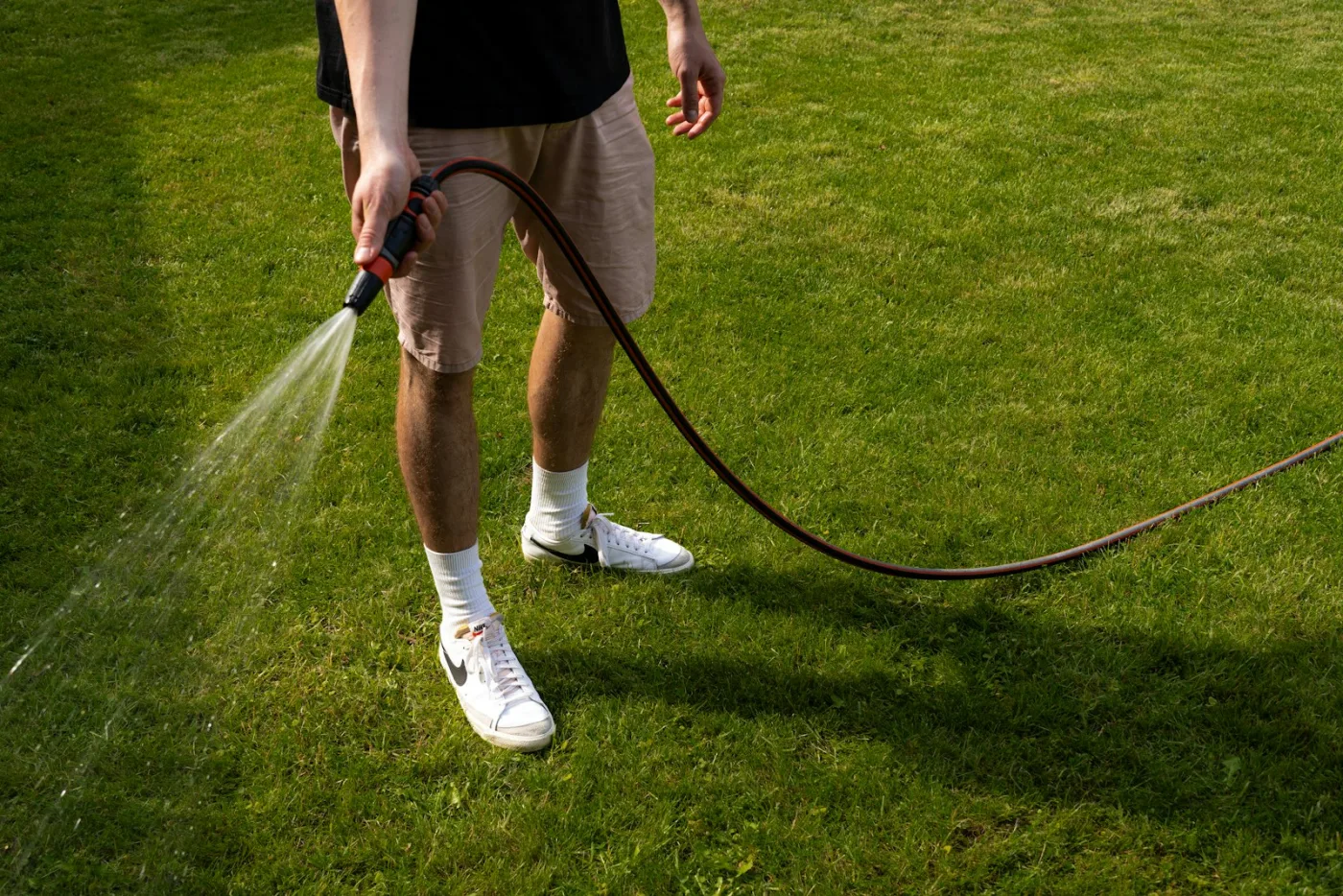
The 21-Day Watering Schedule
This is where most homeowners fail. The watering schedule isn't "water once and walk away" — it's a 21-day program with three distinct phases:
- Days 1-7: Water 2-3 times per day, 10-15 minutes per session. The goal is keeping the top inch of soil consistently moist without standing water. Light frequent watering during germination.
- Days 8-14: Once seedlings reach 1 inch tall, transition to once-daily light watering (15-20 minutes).
- Days 15-21+: Transition to standard 1-inch-per-week deep watering. Use the watering calculator for zone-adjusted amounts.
Skipping or shortening the first 7-10 days of frequent watering kills 50%+ of germinated seedlings before they establish. This is the single most common overseed failure mode.
The First Mow and Beyond
First mow when seedlings reach 4-5 inches. Cut at the standard height for the species:
- Kentucky bluegrass: 3-3.5 inches
- Tall fescue: 3.5 inches
- Perennial ryegrass: 2.5-3 inches
Bag clippings for the first 4-6 weeks while seedlings establish (mulched clippings can clump and smother small seedlings). After three mowings, return to standard mulching.
The Follow-Up Most Homeowners Skip
September overseed plus October second fertilizer plus November winterizer is the program that produces the dramatic results. Skipping October and November after a successful September overseed is the most common reason "I overseeded but the lawn looks the same in spring" — the seedlings never got the carbohydrate reserves to overwinter strongly.
See October lawn care for the second fall fertilizer and November lawn care for the winterizer application.
Frequently Asked Questions
When exactly should I overseed?
Overseed when 4-inch soil temperatures drop back through 75°F and stay below — typically September 1 in Zones 4-5, September 10-15 in Zones 6-7, late September in Zone 8. Use a probe thermometer; calendar-based timing is the #1 cause of overseed failure. Seeding into soil above 75°F drops germination rates by 30-40%.
Should I core-aerate before overseeding?
Aerate first if your soil is compacted (water pools, the screwdriver test fails to penetrate 3 inches, traffic zones are thin). Time the aeration within 2 weeks of overseed so seeds drop into the open core holes. Skip aeration on sandy soils — diminishing returns. For a typical clay-heavy residential lawn, aeration plus overseed is the highest-leverage fall combination.
How much seed do I need?
For full overseed: 4-6 lbs per 1,000 sqft of cool-season seed. For spot/thin-area overseed: 2-3 lbs per 1,000 sqft. Match seed to existing lawn — KBG-dominant blend for KBG lawns, turf-type tall fescue for fescue lawns, sun/shade transitional for mixed-light yards. Don't use bagged "contractor mix" — usually heavy on annual ryegrass that dies the following summer.
How often should I water new seed?
For the first 7-10 days, water lightly 2-3 times per day for 10-15 minutes per session. The goal is keeping the top inch of soil consistently moist without standing water. Once seedlings reach 1 inch tall, shift to once-daily light watering for another week, then standard 1-inch-per-week deep watering after the third mowing.
Can I overseed in spring instead of fall?
You can, but results are materially worse. Spring overseed germinates at 35-45% (pre-emergent applications block most), survives summer heat poorly, and competes with aggressive spring weed germination. Fall overseed germinates at 70-80% and achieves 90%+ winter survival. Same seed, opposite outcomes — entirely from timing. If you missed September, do October 1-7 only in Zones 6-7; past mid-October, wait until next September.
Do I need to bag clippings during overseed establishment?
Bag clippings for the first 4-6 weeks while seedlings establish. Mulched clippings can clump and smother small seedlings. After three mowings of the new grass, return to standard mulching. Outside of newly-overseeded areas, mulching is always preferred over bagging — it returns nitrogen and organic matter to the lawn.
What's the best grass seed for fall overseeding?
Match seed to your existing lawn. For Kentucky bluegrass lawns: a KBG-dominant blend (Award, Midnight, Bewitched cultivars). For tall fescue lawns: a turf-type tall fescue blend (Rebel, Falcon, Titan cultivars). Avoid "contractor mix" — usually 60%+ annual ryegrass that dies in summer. Quality seed costs $5-7 per pound and produces materially better outcomes than $2-3/lb budget seed. Soil test result and zone determine the species; avoid anything labeled simply "lawn mix" without species detail.
Related Resources
- Annual Lawn Care Calendar — full 12-month schedule
- Fall Lawn Care Guide — September through November program
- September Lawn Care — overseed month deep dive
- October Lawn Care — second fall fertilizer + leaf management
- How to Aerate a Lawn — companion procedure for compacted soils
- How to Fix Bare Spots — spot-overseed protocol
- Kentucky Bluegrass Care — KBG-specific overseed timing
- Tall Fescue Care — TTTF-specific overseed timing
- Best Fertilizer Spreaders — calibrated equipment recommendations
- Best Fertilizers — starter fertilizer picks
- Lawn Size Calculator — accurate sqft for seed/fertilizer math